See the working space
Empty the drawer onto a protected surface and wipe out loose debris. Measure the inside, including its usable height when closed. A tall container may fit the open drawer but catch against the cabinet above it. Check that the drawer runs normally before adding an organiser.
Sort the contents by how you use them. Keep the cooking utensils together, for example, instead of dividing everything by colour or material. Move duplicates and rarely used pieces elsewhere so the drawer has a clear purpose.
Try a loose arrangement first
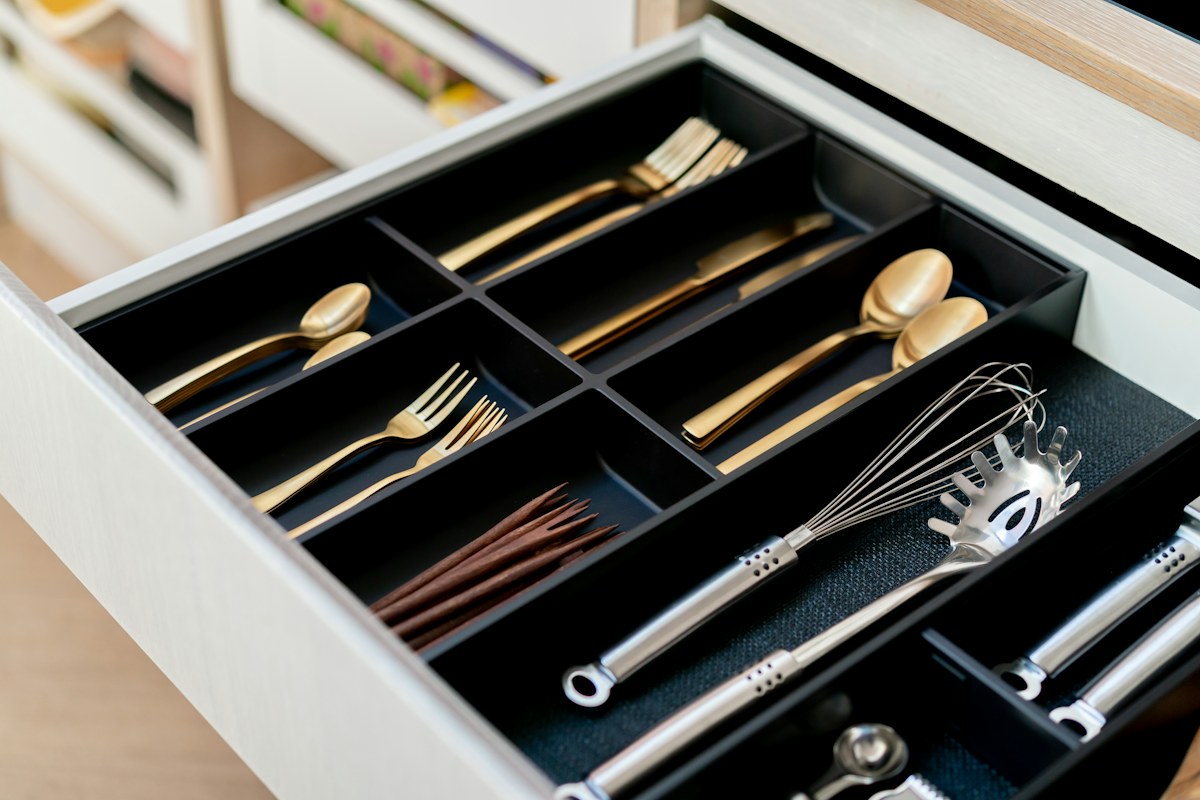
Use existing shallow containers to test the layout before buying a fitted insert. Place the most frequently used objects at the front and leave enough space to lift them without emptying the neighbouring section. Long utensils usually need one uninterrupted channel rather than several tiny compartments.
Open and close the drawer slowly. If loose containers slide, consider a liner suitable for the drawer finish, but avoid sticky material that could mark it. Do not wedge dividers so tightly that they distort a lightweight drawer side.
Keep the arrangement easy to reset
Give each section a simple job rather than a precise item count. A small flexible space for an occasional new object makes the system more realistic. After a week, change whichever compartment you keep ignoring; everyday use is a better test than the first neat photograph.
Before you call it done
- The drawer closes without catching.
- Every compartment is easy to reach.
- Sharp utensils have suitable protected storage.
Know the limit. Keep blades protected and out of children's reach. An open organiser is not a child-safety device.